Children & Video Games: Screen-Time & Gaming Statistics (2026)

Free to use with a link back to ShaneTheGamer — compiled and kept up to date from the public sources listed below. Figures reflect the latest available reporting. Last updated: 2026.
How many children play video games, from what age, for how long — and how many spend money in them? This page gathers the most-cited 2026 statistics on children’s gaming and screen use, drawn from regulator surveys and research, for parenting, education and health coverage.
Key Takeaways for Journalists
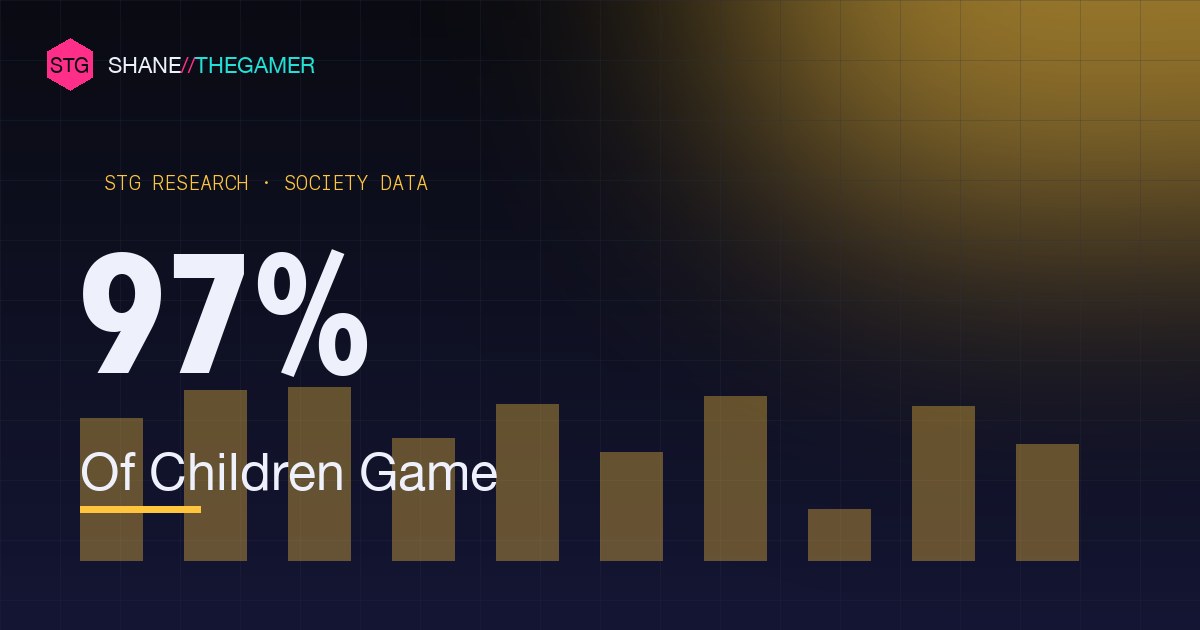
- 97% of 8–17-year-olds play online games — gaming is now near-universal among children (Ofcom).
- 53% of young gamers spend money inside games (skins, passes, loot).
- Children’s gaming time is up ~65% since 2020.
- The typical child gets their first smartphone around age 10–11 — ownership jumps from 56% (age 10) to 83% (age 11).
- 8–14s spend around 3 hours a day online; teens 7–9 hours across all screens.
- Nearly 1 in 4 children own a phone by age 8; 40% have a tablet by age 2.
How Many Children Play Video Games?
Gaming is now an all-but-universal childhood activity. UK regulator Ofcom reports that 97% of 8–17-year-olds play online games, up sharply from younger ages — from roughly four-in-ten pre-schoolers to nearly every teenager. Play spans consoles, PCs, phones and tablets, and gaming time has risen about 65% since 2020.
Do Children Spend Money in Games?
Yes — and increasingly. Around 53% of young online gamers spend real money inside games, on cosmetics, battle passes, currency and loot boxes. This is central to debates over whether randomised paid rewards aimed at minors should be regulated. (See our loot box spending research.)
When Do Children Get Their First Smartphone?
The tipping point is the move to secondary school. Smartphone ownership leaps from 56% of 10-year-olds to 83% of 11-year-olds, per Ofcom. Devices arrive far earlier, though: about 40% of children have access to a tablet by age 2, and nearly one in four owns a personal phone by age 8.
| Age | Own a smartphone |
|---|---|
| 8 | ~24% |
| 10 | ~56% |
| 11 | ~83% |
| 12 | ~91% |
How Much Screen Time Do Children Get?
Averages rise steeply with age: children aged 8–14 spend roughly 3 hours a day online, while teenagers can exceed 7–9 hours across all screens. Health bodies increasingly frame the issue around content, context and balance — sleep, activity and schoolwork — rather than a single screen-time limit.
Problematic Use
Most children’s gaming is healthy and social, but a minority show signs of compulsive use. The World Health Organization recognises ‘gaming disorder’ in its ICD-11 classification, applying to a small share of players who lose control over gaming to the detriment of daily life.
Frequently Asked Questions
What percentage of children play video games?
97% of 8–17-year-olds play online games, according to Ofcom — making gaming near-universal among children.
What age do kids get their first smartphone?
Most children get their first smartphone around age 10–11. Ownership jumps from 56% of 10-year-olds to 83% of 11-year-olds as they start secondary school.
How much screen time is normal for a child?
Averages rise with age — around 3 hours a day online for 8–14s and 7–9 hours across all screens for teens. Experts stress balance and content quality over strict minute limits.
Do children spend money in video games?
Yes — about 53% of young online gamers spend real money in games on skins, passes, currency and loot boxes.
Is gaming bad for children?
For most children gaming is a healthy, social hobby. A small minority show problematic-use patterns; the WHO recognises ‘gaming disorder’ for that group.
Methodology & Sourcing
Figures are drawn from regulator media-use surveys (chiefly Ofcom’s Children and Parents report) and youth-media research (e.g. Common Sense Media). Screen-time-by-age figures are indicative averages synthesised across sources and vary by country and methodology; participation and smartphone-ownership figures are as reported. We update this page as new surveys are published.
Sources
- Ofcom — Children and Parents: Media Use and Attitudes (2026)
- Common Sense Media — youth media use & device ownership
- World Health Organization — ICD-11 ‘gaming disorder’
- UK regulator and research reporting on children’s screen time (2026)
Have newer figures or spot an error? We keep this page current — get in touch via our Contact page.



Join the Conversation