
Ubisoft has quietly turned generative AI fluency into a baseline expectation for new hires, with multiple recent job listings explicitly asking candidates to be comfortable working with tools like ChatGPT, Claude, Copilot, Midjourney, and a growing list of language and image models. The shift signals that the French publisher is moving past the experimental phase of AI adoption and treating it as a standard part of the developer toolkit.
The push lands at a moment when the wider industry is openly split on how far generative AI should be allowed into the creative pipeline, and it puts Ubisoft on a notably more aggressive footing than some of its biggest rivals.
What The Job Listings Actually Ask For
The clearest example is a Technical Art Director role at Ubisoft Annecy, tied to an unannounced AAA project built on Unreal Engine 5 that is widely believed to be the studio’s rumoured live-service multiplayer shooter. The qualifications section, as originally spotted by Tech4Gamers, asked candidates to be proficient in generative AI tools including ComfyUI, Midjourney, NanoBanana, and Hunyuan, and comfortable working with generative AI models such as Claude, Copilot, and ChatGPT.
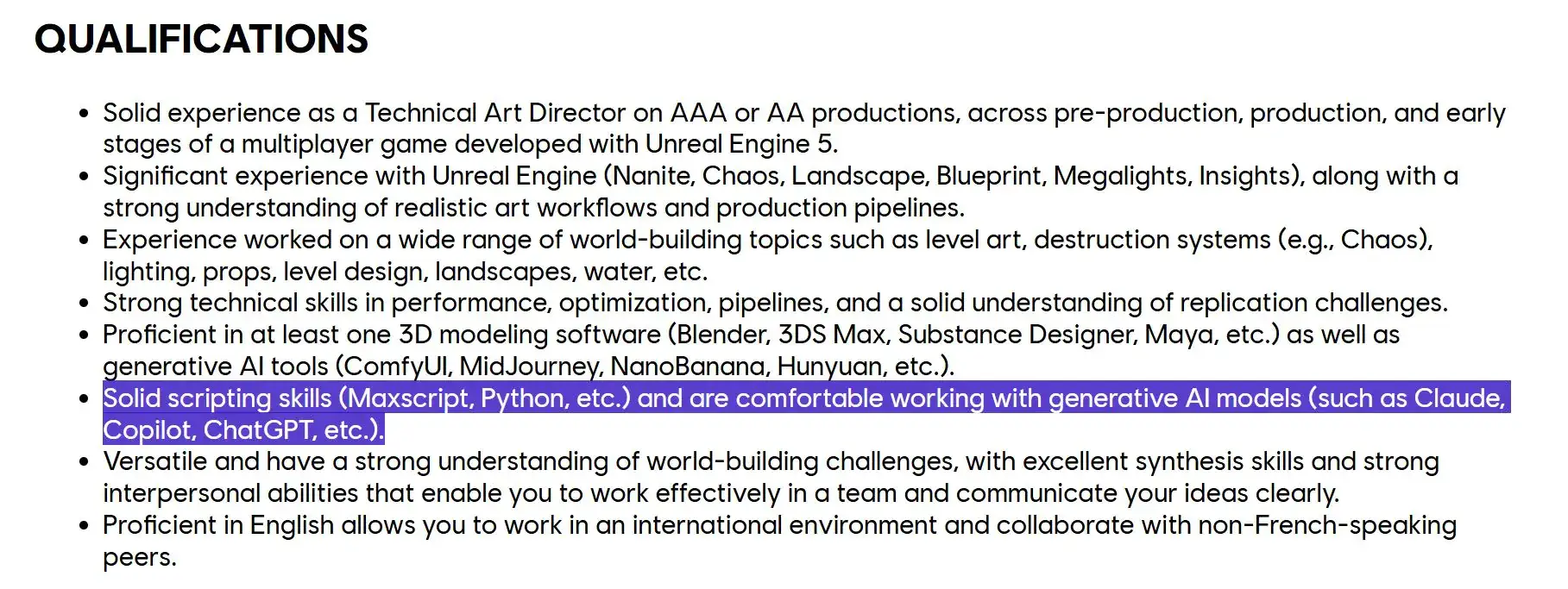
Image via Tech4Gamers
A separate Prompt Specialist opening at Ubisoft Paris goes even further. That role expects a working understanding of multiple large language models, with the listing naming GPT-4, Gemini, Claude, Qwen, SentenceBERT, Llama, and Mistral. The job description frames the position around a single guiding question for the team: out of everything generative AI can do, which applications are actually interesting and fun for gameplay.
Taken together, the two listings suggest the requirement is not a one-off for a niche R&D role. It reads as a company-wide hiring direction.
Ubisoft Has Quietly Edited The Listing Since
After the wording started circulating, Ubisoft updated the Technical Art Director listing on its careers site. The current version no longer mentions Claude, Copilot, or ChatGPT anywhere. The scripting bullet that previously paired Maxscript and Python with comfort using generative AI models has been trimmed back to just the scripting requirement.
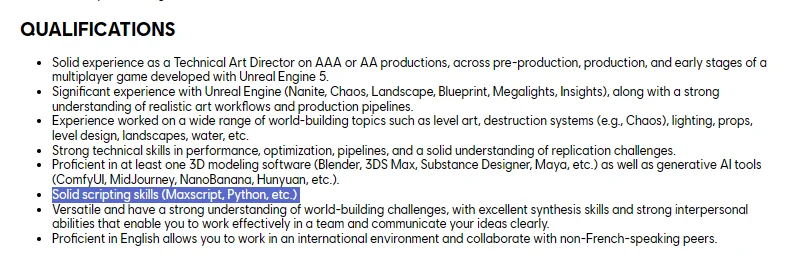
The bullet covering 3D modelling software has been left untouched, which means the requirement to be proficient in generative AI tools like ComfyUI, Midjourney, NanoBanana, and Hunyuan is still in place. Ubisoft has not publicly explained the change, and the Prompt Specialist role at Ubisoft Paris still openly lists the full lineup of language models. The selective nature of the edit suggests this is less about backing away from AI and more about managing which kinds of AI are most visible in public-facing job ads.
Where Ubisoft Might Actually Use These Tools
Ubisoft has not spelled out exactly how generative AI will be applied across its projects, but the Technical Art Director role offers a strong hint. The most likely use case is concept ideation, where AI-generated imagery is used early in the pipeline before being replaced by hand-crafted assets later in production. That approach has already shown up in other recent releases, including Clair Obscur: Expedition 33 and Crimson Desert, the latter of which was found to still contain leftover AI-generated art from early development.
The Prompt Specialist role points to something more experimental. Ubisoft has previously demonstrated AI-driven NPCs in a playable research project called Teammates, designed to test how generative systems could power more responsive in-game characters. A dedicated prompt engineering hire suggests the company wants to push that kind of work further, with someone whose entire job is figuring out which model behaviours translate into actual gameplay value.
Read More: Gustave Actor Wants Robert Pattinson To Play Gustave In Clair Obscur Expedition 33 Movie
Read More: Ubisoft Toronto Lays Off 40 Staff, Splinter Cell Remake Still In Development
An Industry That Cannot Agree On AI
Ubisoft’s hiring direction stands in sharp contrast to where some of its peers are landing. Take-Two Interactive, the publisher behind GTA 6, recently parted ways with its head of AI Luke Dicken and an undisclosed number of staff from its AI division, despite CEO Strauss Zelnick publicly stating the company is actively embracing generative AI across its studios. Reports also suggest there is very little AI usage in GTA 6 itself, which lines up with Zelnick’s repeated insistence that human creativity remains the primary driver of development.
Other publishers are leaning in the opposite direction. NetEase has openly praised AI integration across the full development and gameplay cycle, while Capcom has outlined a formal AI policy aimed at boosting productivity. The result is a fractured industry where the same technology is being treated as essential infrastructure by some studios and as a liability by others.
Ubisoft’s stance, judging purely by what it is asking new hires to bring to the table, sits firmly in the pro-integration camp.
The Wider Hiring Signal
Listing generative AI experience as a qualification, rather than a nice-to-have, changes what the studio is selecting for. It pushes candidates who have already built workflows around tools like Claude and ChatGPT to the front of the queue, and it sets an expectation that future Ubisoft developers, artists, and designers will treat these models as part of their daily kit.
It also raises the question of how Ubisoft plans to communicate this to players. The community response to AI in games has been uneven at best, with backlash following everything from AI-voiced NPCs in Arc Raiders, which the studio is now replacing with real voice actors, to Nvidia’s DLSS 5 showcase that demonstrated visible NPC quality degradation. Studios that bake AI deep into their pipelines without a clear story risk running into the same friction.
What Comes Next
If Ubisoft follows through on the direction these listings imply, the unannounced Annecy project could become an early test case for how a major publisher integrates generative AI into a live-service title from the ground up. Whether that translates into faster production, more reactive gameplay systems, or simply more efficient concept work will depend heavily on how the new hires choose to apply the tools they are being asked to master.