

Ubisoft is facing one of the darkest moments in its 40-year history. Shares in the Assassin’s Creed publisher plunged by as much as 33 percent after the company unveiled a sweeping organisational reset, cancelled six games, confirmed studio closures and layoffs, and revealed a bleak financial outlook.
What has raised even more eyebrows, however, is that amid all this turmoil, Ubisoft also confirmed it plans to double down on generative AI, pouring more money into player-facing artificial intelligence despite widespread backlash from the gaming community.
Shares Suffer Worst Drop Since Listing
Shares in Ubisoft tumbled in early Paris trading, putting the stock on track for its biggest one-day fall since the company went public in 1996. At its lowest point, Ubisoft’s market value fell to roughly €616 million, a stunning collapse from its peak valuation of around €11 billion in 2018.
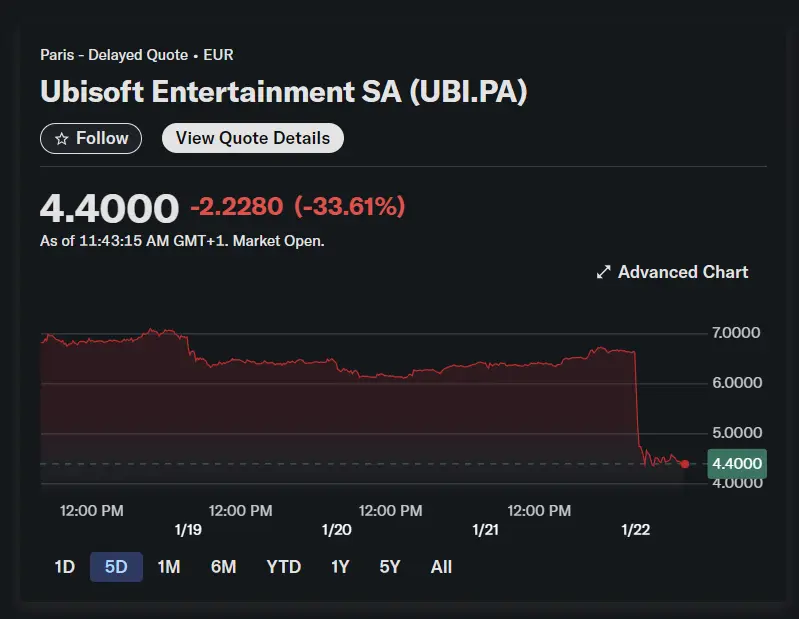
The sell-off reflects years of declining performance following the pandemic, repeated delays to major releases, and mounting concerns over Ubisoft’s ability to return to consistent profitability.
Six Games Cancelled, Prince Of Persia Scrapped
As part of its overhaul, Ubisoft confirmed it has cancelled six games outright. The only project named publicly is the long-troubled Prince of Persia: The Sands of Time Remake, which had already been rebooted once and spent years in development.

Image Credit: Ubisoft
According to Ubisoft, three of the cancelled titles were new IPs, while one was a mobile game. The company said it is refocusing its portfolio toward open-world adventures and live-service experiences, areas it believes offer the strongest long-term returns in a more selective AAA market.
Major Delays Including Black Flag Remake
In addition to the cancellations, Ubisoft is delaying seven more games. While the company did not name these projects, the list includes an unannounced title previously expected before March 31, which is widely believed to be a remake or remaster of Assassin’s Creed IV: Black Flag.
That title is now expected to launch in the next financial year, before March 31, 2027, pushing a potential fan favourite further down the line.
Studios Closing And Layoffs Expand
The restructuring will see Ubisoft close two studios entirely. Ubisoft Stockholm is shutting down, after previously contributing to Avatar: Frontiers of Pandora, alongside the mobile-focused Ubisoft Halifax studio.
Further restructurings and layoffs are also underway at Ubisoft’s offices in Abu Dhabi, Helsinki and Malmö, as well as at RedLynx and Massive Entertainment. Ubisoft has also confirmed a return-to-office mandate, requiring staff to work on-site five days a week, with a limited allowance for remote days.
Five Creative Houses Reshape The Company
Ubisoft is radically reshaping its internal structure by splitting development and publishing into five decentralised Creative Houses, each operating as an integrated business unit with full creative and financial responsibility.
Vantage Studios will oversee Ubisoft’s biggest franchises, including Assassin’s Creed, Far Cry and Rainbow Six. Other Creative Houses will focus on shooters like The Division and Ghost Recon, live-service games such as For Honor and Skull and Bones, narrative and fantasy titles including Rayman and Prince of Persia, and family and casual games like Just Dance and Uno.
Ubisoft says this model is designed to speed up decision-making, sharpen creative focus, and place accountability closer to where value is created.
Ubisoft Still Doubling Down On Generative AI
Despite cancelling games, closing studios and projecting massive losses, Ubisoft has confirmed it will continue to invest heavily in generative AI, and not just behind the scenes.
In its official statement, Ubisoft revealed that its new operating model will be supported by “accelerated investments” into player-facing generative AI. This suggests the technology will appear directly in games, potentially influencing visuals, writing, or interactive systems, rather than being limited to internal tools like testing or optimisation.
This decision has already sparked controversy. Generative AI remains widely rejected by many players, particularly when used in creative roles, and Ubisoft’s relationship with its community is already strained. While the move may appeal to investors eager to hear anything involving AI, critics question whether it risks pushing even more players away at a time when trust is already fragile.
Billion Euro Loss Expected By 2026
The financial picture remains grim. Ubisoft expects to post an operating loss of around €1 billion for the financial year ending 2026, driven in part by a €650 million write-down linked to cancelled and delayed projects.
Net bookings for 2026 are now forecast at roughly €1.5 billion, €330 million below previous guidance. Ubisoft has withdrawn its earlier outlook for fiscal years 2026 and 2027 entirely, and says it may consider selling assets as it works to stabilise its finances.
Cost-cutting measures are expected to save around €500 million, with fixed costs targeted to fall to €1.25 billion by March 2028, down from €1.75 billion in 2023.
Ubisoft Admits A Hard Reset Is Underway
Founder and CEO Yves Guillemot described the changes as a decisive turning point, saying Ubisoft must fundamentally rethink how it operates to survive in a more competitive AAA landscape.
While Guillemot insists the reset will eventually restore sustainable growth and cash generation, analysts remain cautious, warning that a return to positive cash flow still appears distant.
Between mass cancellations, sweeping layoffs, and a controversial bet on generative AI, Ubisoft is taking one of the biggest gambles in its history. Whether it marks the start of a genuine recovery or accelerates the company’s decline is a question only time, and players, can answer.