

Sony is rolling out mandatory age verification for PlayStation users who want to keep using communication features, according to an email from Sony Interactive Entertainment that started landing in player inboxes this week. Messages, voice chat, and party features will all sit behind the new check, with a global rollout planned for later in 2026 and a confirmed start date of June 2026 for the UK and Ireland.
Players who skip the verification step will still be able to play games, earn trophies, and use the PlayStation Store. The restriction only targets the social layer of the platform, which is where most of the regulatory pressure around under-age users has been focused over the past year.
What Sony’s Email Actually Says
The email, first reported by Insider Gaming, frames the change as part of Sony’s compliance with global regulations. It tells users they will need to verify their age later this year to continue using PlayStation communication features such as messages and voice chat, and that other services will remain accessible without verification.
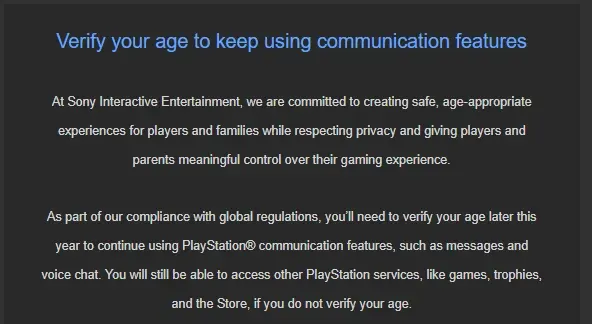
Sony has not attached a specific global date to the notice. The company has, however, locked in a June 2026 start for the UK and Ireland, where the verification page is already live and some users are being prompted to complete the process ahead of enforcement.
Which Features Get Locked Behind Verification
The list of affected features goes further than just console-level chat. Based on the rollout details confirmed for the UK and Ireland, verification will gate communication, broadcasting, and certain in-game functions.
- Joining a party and voice chat
- Text messaging between players
- Third-party chat programs launched through the console, including Discord
- In-game chat inside supported titles
- Sharing user-generated content
- Broadcasting features
Everything outside that social layer, including single-player sessions, online matchmaking that doesn’t require comms, trophies, and PlayStation Store purchases, stays available whether or not a player verifies.
How The Verification Works
Sony is using Yoti, a third-party identity company, to handle the checks in the UK and Ireland. Players in those regions can verify through a face scan or by uploading a government-issued ID. The assumption across reporting is that Yoti will remain the provider when the rollout expands, though Sony has not formally named a partner for other regions.
Yoti markets itself on a privacy-first approach, but the company has a recent record worth flagging. In January, Spain’s data-protection regulator AEPD fined Yoti $1.1 million for mishandling biometric data collected from users. That detail is likely to follow Sony’s rollout into every market it expands to.
Read More: PS6 Price Could Hit $999 As Analysts Warn Of Next-Gen Cost Surge
Age Verification Is Becoming A Platform-Wide Trend
Sony is not the first major gaming platform to move in this direction, and the push is being driven as much by regulation as by company policy. Several countries and US states adopted age-verification laws through 2025, framed around protecting minors from inappropriate content. The momentum has carried into 2026, even as privacy researchers continue to raise doubts about whether the laws actually achieve their stated goals.
Discord
Discord announced its own verification system for rollout by March 2026 and faced significant backlash from users worried about data handling. The company pushed its plans to the end of 2026 and now says most users will not need to verify at all, a walk-back tied to concerns about personal data and anonymity.
Roblox
Roblox introduced mandatory verification in January, requiring users to upload a photo before accessing in-game chat. The rollout has not gone smoothly, with ongoing questions about how well the system works and how the collected data is handled.
US Legislation
The US House of Representatives is currently reviewing the Parents Decide Act, which could go considerably further than any platform-level measure by requiring age verification before users can access a computer’s operating system at all.
The Privacy Question Sony Will Have To Answer
Biometric verification at this scale raises the same concerns that have dogged Discord and Roblox. Critics have pointed to the risk that identity data could be leaked, used to track consumer behaviour across apps, or handed to governments without clear user consent. Sony’s choice of provider puts that concern on the record before the global rollout even begins, given the AEPD ruling earlier this year.
For players, the practical trade-off is straightforward. Skip verification and keep playing, but lose access to the social features that define how a lot of people actually use the console. Verify, and trust that Sony and its partner handle the resulting data responsibly.
What Else Is Changing On PlayStation
The verification rollout lands alongside another significant shift. Sony plans to phase out all PlayStation Network branding by September 2026, though the online services themselves are not going anywhere. PSN is expected to return under a new name rather than be dismantled, suggesting a broader rebrand of the platform’s online identity is in motion at the same time the verification system is being introduced.
A firm global date for the verification requirement is still the main missing piece. Until Sony confirms one, players outside the UK and Ireland have time to decide how they want to handle the check, but the direction of travel across the industry makes it clear that opting out of verification will increasingly mean opting out of the social side of gaming.