
The Pokemon Company has launched the Pokemon Trading Card Game AI Battle Challenge, a developer contest that tasks teams with building AI agents capable of playing the Pokemon TCG at a competitive level. Announced on 16 June 2026 and run in partnership with Kaggle, the Google-owned machine learning platform, the challenge opened to entrants the same day and carries a prize pool that exceeds $290,000 across two rounds.
本日6月16日(火)より、「ポケモンカードゲーム AI Battle Challenge」を開始!
ポケモンカードゲームのプレイを競う、AIエージェントの開発コンテストだよ。
くわしくはこちら!https://t.co/7OKfEFrG6B #ポケカ #ポケカABC #PTCGABC pic.twitter.com/gLc6X2Jfxf— ポケモン公式 (@Pokemon_cojp) June 16, 2026
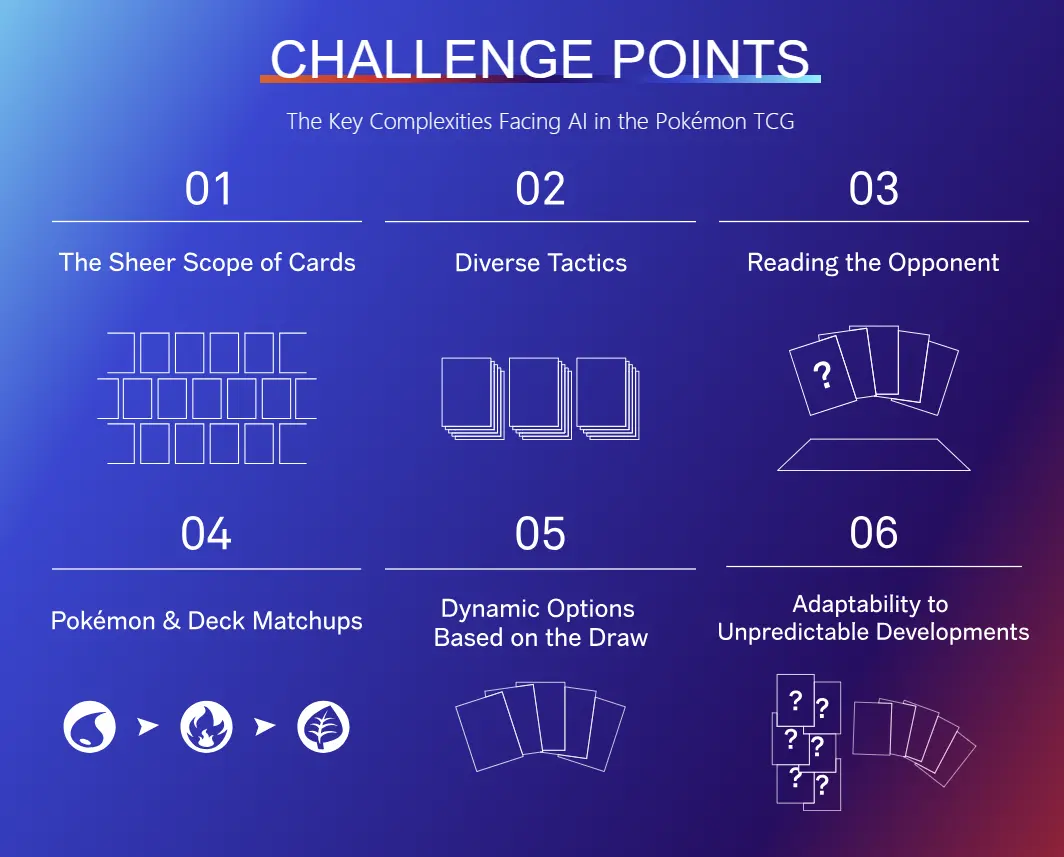
The contest frames itself as the next strategic board game for AI to conquer, following chess, shogi, and Go. Where those games are fully observable, the Pokemon TCG hands an AI a harder problem: a pool of over 1,000 cards, hidden hands, type matchups, coin tosses, and draw-based variance that means no two games play out the same way.
What The Pokemon TCG AI Battle Challenge Is
Participants build an AI training agent that constructs a 60-card deck from an organiser-provided card pool and plays full matches under Pokemon TCG rules, adjusted specifically for the competition. Only cards from the supplied list are legal, and each player gets a maximum of 10 minutes per match, with any player who runs out the clock losing that game.
The organisers are upfront that rule-based programming alone is unlikely to score well. Winning requires forward planning, real-time adaptation, and sound decision-making under uncertainty, with the core difficulty being that an agent never knows what its opponent is holding. Teams are given a simulator SDK that mirrors the Kaggle competition environment, suitable for local debugging and reinforcement learning. Matches run on the cabt Engine, a Pokemon TCG battle simulator built for kaggle-environments, which presents the agent only legal moves each turn.
The event is organised by The Pokemon Company alongside the Matsuo Institute and HEROZ, with support from Google, Google Cloud, and Nvidia.
The First Round Splits Into Two Categories
The first round runs as two separate but linked categories, and entry into the Simulation Category is required to compete in the Strategy Category.
Simulation Category
The Simulation Category is the head-to-head ladder. Teams submit up to five agents per day, each agent playing automated matches against others of a similar skill rating on Kaggle. Skill is modelled as a Gaussian rating that rises with wins and falls with losses, with only a team’s two most recent submissions tracked for final standings. The margin of a win does not affect the rating, only the result. Submissions run from 16 June through to the final deadline on 16 August 2026, after which games continue for roughly two weeks until the leaderboard converges and is locked. No prize money is attached to this category on its own.
Strategy Category
The Strategy Category is where the prize money sits, and it scores the thinking behind the agent rather than raw win rate. Teams submit a written report, capped at 2,000 words, explaining their strategic logic, deck concept, and design decisions. Scoring weights the model approach at 70 percent, the deck concept at 20 percent, and report quality at 10 percent. Crucially, a high ladder ranking helps but does not guarantee a strong result, and the organisers note that teams in the middle or lower tiers can still place highly through original analysis and well-structured reporting. This category runs from 16 June to a final submission deadline of 13 September 2026, with judging from 14 September to 11 October 2026.
Prize Pool And Round Structure
The challenge pays out across both rounds, with the bulk of the money distributed in the first round’s Strategy Category. The top eight teams from the Strategy Category each receive $30,000 and advance as finalists to the second round. If any of the top eight decline their invitation, the spot rolls down to the next highest-ranked team.
The second round adds a further winner-takes-more structure on top. The breakdown across both rounds is below.
| Round | Placement | Award |
|---|---|---|
| First Round – Strategy | 1st to 8th place (per team) | $30,000 each |
| Second Round | Winner | $50,000 |
| Second Round | Runner-up | $30,000 |
| Second Round | All participants (per individual) | $3,000 in Google Cloud credits |
That puts $240,000 in play across the eight first-round finalist teams alone, before the second round’s $50,000 winner prize, $30,000 runner-up prize, and per-individual Google Cloud credits are added.
The Second Round And Tokyo Finals
The eight finalists advance to a second round held later in 2026. The Pokemon Company plans to host the finalists at an in-person tournament in Tokyo, Japan, with the exact date still to be confirmed. Footage from the second round is expected to stream on YouTube from late 2026 onward.
How To Enter
Both categories run on Kaggle, and the same start date of 16 June 2026 applies to each. For the Simulation Category, the entry and team merger deadline is 9 August 2026, with final submissions due 16 August. For the Strategy Category, the entry and merger deadline is 6 September 2026, with final submissions due 13 September. Submissions for the Simulation Category take the form of a packaged agent bundle uploaded through Kaggle, while Strategy entries are submitted as a Kaggle Writeup with an attached media gallery.
Full rules, the card pool, the simulator documentation, and entry links are available on the official Kaggle pages for the Simulation Category and the Strategy Category. With the Simulation ladder locking on 16 August, teams have just under two months to get a working agent onto the board.