
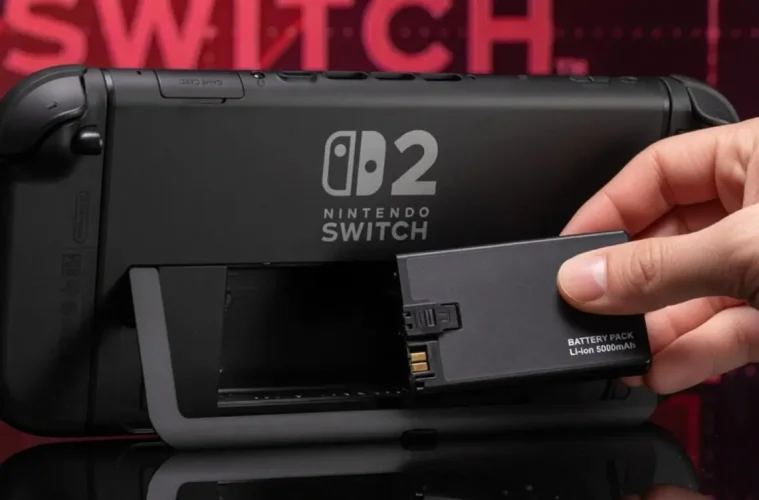
Nintendo have confirmed a revised version of the Switch 2 is heading to European shelves with a user-replaceable battery, with the new units carrying an additional ‘OSM’ code on the packaging to mark them as separate products for regulatory purposes. The refresh applies to current Switch 2 hardware bearing model numbers that start with BEE, and is timed to land before the 18 February 2027 deadline set by the EU Batteries Regulation. The same compliance work also covers the Joy-Con 2 controllers and the Switch 2 Pro Controller, all of which currently ship with built-in batteries that cannot be swapped without disassembly.
As of June 2026, the original Switch 2 hardware remains the only configuration on sale across Europe, with the OSM-coded variants confirmed but not yet attached to a public release window. Nintendo’s compliance notice signals an arrival ahead of the regulatory cut-off rather than alongside it, leaving the gap between announcement and launch as the open question.
What The OSM Code On Packaging Means
The OSM designation is the marker shoppers in the EU will use to tell a compliant revised unit from the launch version. Nintendo’s compliance notice states that future versions of current BEE-series products will receive unique model numbers and carry the OSM code visible on the packaging, separating them from the original hardware for regulatory tracking. The current Switch 2 console ships under model code BEE-001, so a future revised SKU will sit alongside that number with the OSM tag attached.
For the buyer scanning the box in a European retailer in late 2026 or early 2027, the OSM mark is the at-a-glance signal that the unit inside meets the replaceable-battery requirement. The launch Switch 2, which lacks the code, will continue to coexist on shelves through retailer stock cycles. Nintendo has not announced a trade-in path or any swap programme between the original and the OSM-coded revisions, meaning the original BEE-001 units already in homes are unaffected by the regulatory change.
EU Batteries Regulation Drives The Hardware Refresh
The EU Batteries Regulation, adopted in 2023, sets 18 February 2027 as the date by which consumer products with built-in batteries sold in the EU must be easily removable and replaceable by end-users at any time during the lifetime of the product. The rule is part of a wider EU effort to cut the environmental cost of manufacturing, using, and recycling rechargeable batteries, with replaceable-cell design intended to extend product lifespan and reduce e-waste at end-of-life.
Comunicado oficial, aquí les dejo lo importante:
“Nintendo ya está preparando nuevas versiones de sus productos para cumplir plenamente con esta regulación. Los productos actuales con modelos que empiezan por “BEE” tendrán versiones futuras con números de modelo únicos y… pic.twitter.com/KHHH8RhFLa
— eXtas1s 🎮 Noticias & Rumores (@eXtas1stv) June 4, 2026
The current Switch 2’s internal battery is sealed behind screws and adhesive in a configuration that requires a teardown to access, placing the launch hardware outside the regulation’s threshold. Nintendo’s revision work brings the EU SKUs into line with the new standard without changing the underlying console architecture, which means the OSM-coded units are expected to behave identically to launch hardware in software, performance, and game compatibility. The redesign work sits on the chassis and the battery enclosure rather than on the system-on-chip or the dock.
The regulation applies to the EU market specifically, so Nintendo’s compliance work is regional rather than global. Hardware sold under the same BEE codes outside the EU is not affected, and the OSM marker is the result of EU-specific regulatory tracking rather than a worldwide product change.
Joy-Con 2 And Pro Controller Likely Also Affected
The same battery rule that applies to the console covers the Joy-Con 2 controllers and the Switch 2 Pro Controller, both of which carry built-in rechargeable cells that cannot be swapped without disassembly. Joy-Con 2 controllers ship under model numbers BEE-012 and BEE-014, while the Pro Controller carries BEE-008, all of which sit inside the BEE series Nintendo has flagged for revision.
Nintendo did not name the controllers individually in its compliance statement, but the BEE-series language covers them by default, and a parallel set of OSM-coded controller SKUs is the logical implication. A revised Joy-Con 2 with an end-user-replaceable cell would be a structural redesign rather than a minor tweak, given the slim handheld form factor, the rail attachment, and the existing internal layout. The Pro Controller has more internal volume to work with, and a screw-access battery compartment would be the simplest route to compliance.
BEE-Series Models Covered By The Revision
| Model Number | Product | Built-In Battery | Revision Status |
|---|---|---|---|
| BEE-001 | Switch 2 console | Yes | OSM-coded SKU confirmed |
| BEE-008 | Switch 2 Pro Controller | Yes | Implied by BEE-series compliance |
| BEE-012 | Joy-Con 2 | Yes | Implied by BEE-series compliance |
| BEE-014 | Joy-Con 2 | Yes | Implied by BEE-series compliance |
Original BEE Series Stays In Distribution
Nothing in the compliance notice forces Nintendo to pull the launch hardware off EU shelves before the OSM-coded variants arrive. Retailers can continue to sell through their existing BEE-001 stock, and the original units remain fully supported, with the regulatory line drawn at units sold after the 18 February 2027 deadline rather than at hardware already in circulation.
For the existing Switch 2 owner in Europe, the practical situation is unchanged. Battery replacement on the launch unit still requires a service centre or a third-party repair, and Nintendo has not signalled any change to its existing repair pricing or turnaround in response to the regulation. The compliance work targets new units entering the market, not retroactive servicing of hardware already sold.
What Buyers In Europe Need To Watch For
The OSM code on the packaging is the single confirmation point. Shoppers picking up a Switch 2, Joy-Con 2 set, or Pro Controller in an EU retailer between now and February 2027 will see a mix of launch SKUs and OSM-coded variants depending on when the revised units enter retail channels. Nintendo has not published a regional release date for the revised hardware, and there is no public update on whether the OSM units will carry a different recommended retail price.
The revision applies to the EU market specifically. Switch 2 hardware sold in the United Kingdom, the United States, Japan, Australia, and New Zealand falls outside the EU Batteries Regulation and is not covered by the compliance statement, which means the OSM code is unlikely to appear on units sold in those regions. Cross-border purchases from EU retailers will pick up the revised hardware where stock cycles align, but importers will need to confirm warranty terms with their local Nintendo support arm before relying on EU-bought hardware long-term.
The Next Confirmation Point
Nintendo’s compliance notice sets a hard regulatory deadline of 18 February 2027 but no public release date for the OSM-coded hardware. The next concrete signal will be the appearance of revised model numbers in EU retailer listings or a follow-up Nintendo statement naming the launch window for the compliant SKUs, with the most likely surface point being the next EU regulatory filing or a dedicated consumer-information update on the Nintendo regional site.