
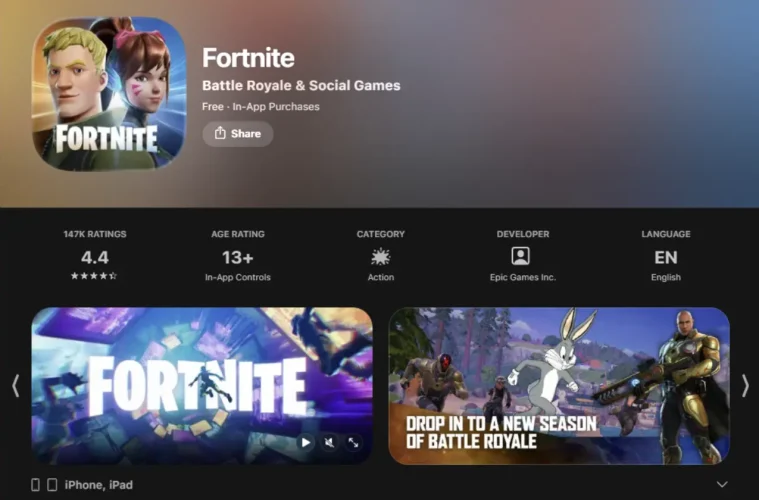
Epic Games have returned Fortnite to the iPhone and iPad App Store in every country except Australia, ending a nearly six-year absence from Apple’s mobile platform. The game went live globally on 19 May 2026, restoring direct iOS downloads for the first time since Apple pulled the title in August 2020 over a payment-rules dispute. Epic CEO Tim Sweeney framed the return as a calculated strike at Apple’s commission structure, writing on X that it marks the “beginning of the end of the Apple Tax worldwide.”
Fortnite is back on the Apple App Store as we head into the final battle of Epic v Apple in court. For years, Apple has fragmented iOS features and fees by territory, taking regulatory negotiating positions in secret, and intentionally delaying the pursuit of justice. https://t.co/9DMuf4SmKO
— Tim Sweeney (@TimSweeneyEpic) May 19, 2026
The worldwide rollout is the latest turn in a legal fight that has run since 2020, and Epic timed it to coincide with Apple’s own admission to the U.S. Supreme Court that regulators across the globe are watching how the case is decided.
Why Apple Removed Fortnite in 2020
Fortnite vanished from the App Store in August 2020 after Epic added a direct payment option to the iOS version of the game, deliberately breaking Apple’s rule that all in-app purchases must run through Apple’s own billing system. The change let players buy V-Bucks straight from Epic at a lower price than the App Store version allowed.
Apple removed the title within hours, citing the payment-rules violation. Epic had prepared for the response, and the company filed suit against Apple, opening the Epic v Apple legal battle that has shaped App Store policy ever since. The dispute centred on a single question that still drives the fight in 2026, whether Apple can require developers to use its payment system and the commission attached to it.
The removal cut Fortnite off from one of its largest player bases. iPhone and iPad owners who had not kept the app installed lost any route back to it, and the game stayed off Apple hardware worldwide while the case moved through the courts. That standoff held for years before a series of rulings began to chip away at Apple’s position.
The Court Rulings That Forced Fortnite Back
The path back to iPhones ran through a chain of U.S. court rulings rather than any settlement between the two companies. Fortnite returned to the U.S. App Store in May 2025, almost five years after it was removed, and that reinstatement only happened under direct pressure from the bench.
District Judge Yvonne Gonzalez Rogers threatened to require the Apple executive overseeing app approvals to appear in court, a move that effectively forced Apple to clear Fortnite’s return for American players. The decision restored the game for one market but left it blocked everywhere else, as Apple kept the title off the App Store across the rest of the world while it pursued appeals.
The final barrier fell in late April 2026, when the Ninth Circuit Court of Appeals reversed a stay that had allowed Apple to pause its compliance with rulings on App Store fees. Lifting that stay removed Apple’s legal cover for keeping Fortnite blocked outside the United States. Within weeks, Epic moved to push the game live in every market it could reach, and the worldwide rollout followed on 19 May 2026.
Epic’s ‘Final Battle’ Against the Apple Tax
Epic has framed the global return as the opening of what it calls the final battle over Apple’s commission, the fee structure the company refers to as the Apple Tax. The timing was chosen with that fight in mind. In filings before the U.S. Supreme Court, Apple acknowledged that “regulators around the world are watching this case to determine what commission rate Apple may charge on covered purchases in huge markets outside the United States.”
Epic argues that admission works in its favour. The company said it brought Fortnite back now because it is confident that once a U.S. federal court forces Apple to be transparent about how it calculates App Store fees, governments elsewhere will refuse to let what Epic calls junk fees stand. In its official statement, Epic said it will “continue to challenge Apple’s anticompetitive App Store practices of banning alternative app stores and competition in payments.”
The company pointed to regulatory momentum in Japan, the European Union, and the United Kingdom, where lawmakers have passed measures aimed at opening up mobile app distribution. Epic argues the results have fallen short of the intent, saying Apple has “evaded the laws with scare screens, fees and onerous requirements” each time new rules have taken effect. That pattern, in Epic’s telling, is why it expects the U.S. case to carry weight well beyond American borders.
Read More: Fortnite Mobile – How to Download and Play on iPhone and Android | Epic vs Apple – Full Timeline of the App Store Legal Battle
Which iPhones and iPads Can Download Fortnite
With the game restored to the App Store, players on supported Apple devices can download Fortnite directly through the standard “Get” button, with no sideloading or third-party app store required. The game runs on a broad range of recent hardware.
| Device Type | Minimum Supported Model |
|---|---|
| iPhone | iPhone 11 or newer |
| iPad | 10.5-inch iPad Pro or newer |
Both core modes are available from launch. Players can drop into the standard Battle Royale mode or the building-free Zero Build mode straight from the App Store version, with no separate download needed for either.
The return also restores Epic’s own payment system inside the app. Players can buy V-Bucks, Fortnite’s in-game currency, through Epic’s direct billing rather than Apple’s, which avoids the markup that Apple’s standard 30 per cent commission would otherwise add to each purchase. That billing choice sits at the centre of the wider dispute, since offering an alternative to Apple’s payment system is the exact practice that had Fortnite removed in 2020.
Why Australia Is Still Blocked
Australia is the one major market where Fortnite has not returned to the App Store. The exclusion is not a technical holdup but a continuation of the same fight playing out everywhere else. Epic won its court case against Apple in Australia, where the Court found that many of Apple’s developer terms are unlawful.
Despite that ruling, Apple has continued to enforce the terms the Court rejected. Epic says it cannot bring Fortnite back to the Australian App Store under what it describes as an illegal payment arrangement, and the company has chosen not to return on those terms. Instead, Epic is asking the Court to order Apple to stop enforcing the conduct already found unlawful.
Until that order arrives, Australian iPhone and iPad owners remain locked out while players in the rest of the world regain access. The Australian case now stands as the next test of whether Epic’s courtroom strategy can deliver the App Store changes the company has spent nearly six years pursuing, with Epic awaiting a ruling that would force Apple to bring its terms into line with the Court’s decision.