

Marvel Rivals might be the new kid on the competitive shooter block, but it’s already making big moves in how it wants its esports scene to grow. And if you’re expecting it to follow the same franchising path we’ve seen in other big titles, think again.
Right now, the game is in the middle of its first-ever LAN event, the Marvel Rivals Ignite Mid-Season Finals, part of a whopping $3 million Ignite series that’s been helping put the game on the esports map. Naturally, that’s got fans wondering: where does competitive Marvel Rivals go from here?
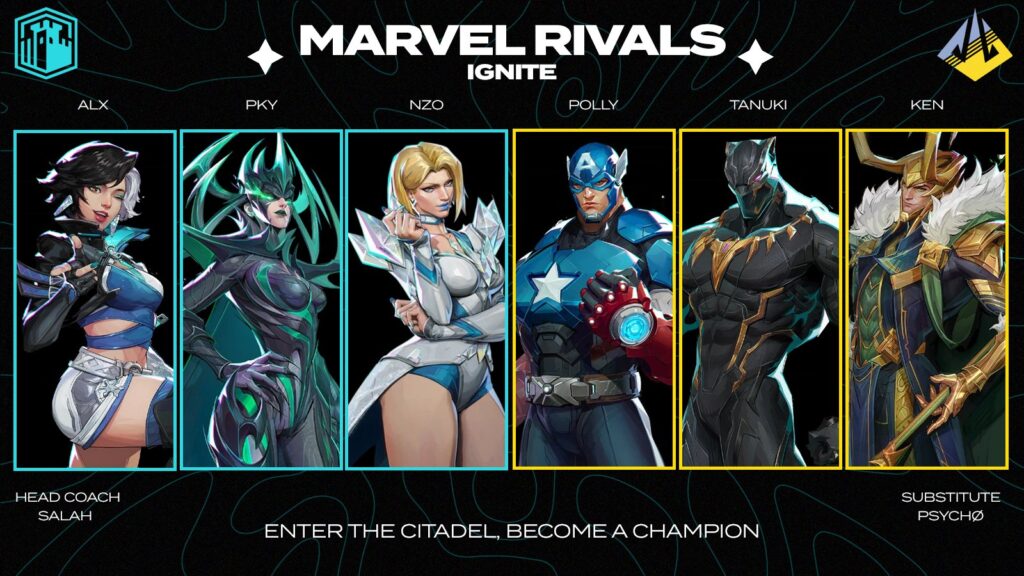
Image Credit: NetEase Games
Learning from the Overwatch League’s Missteps
Marvel Rivals sits in the same “hero shooter” category as Overwatch, so comparisons are unavoidable. The Overwatch League went with a franchise model, where teams paid around US$20 million for a permanent spot. This meant no relegations, which was great for stability and appealing to sponsors, but also led to things feeling a bit stale for fans.
In the end, that model didn’t save it. The Overwatch League folded in 2024, leaving a big “what not to do” example for newer titles.
The Overwatch League is officially ending after 6 seasons pic.twitter.com/6g4ka9xnRn
— Dexerto (@Dexerto) January 23, 2024
Marvel Rivals’ Head of Esports, Adam Huang, has made it clear in an interview with Jake Lucky that NetEase isn’t rushing into the same structure:
“For the beginning we will not undergo this, because they will restrict how we behave. We want to go independently… If everything goes smoothly, we’ll consider every possibility in the future.”
Marvel Rivals will not be pursuing a Franchise League model for the foreseeable future, according to Adam Huang, their lead of Esports Tournaments
“I think for the beginning we will not do this, because they will restrict how we behave” pic.twitter.com/wVEi9RGekx
— Jake Lucky (@JakeSucky) August 7, 2025
So, What’s the Franchise Model Exactly?
In simple terms, a franchise model is when teams buy their way into a league and keep their spot no matter how well, or badly, they perform. Think of it like buying a permanent seat at the table.
Call of Duty League is a prime example, with city-based teams like Atlanta FaZe or London Royal Ravens. League of Legends has the LCS, and Mobile Legends: Bang Bang runs its MPL (Mobile Legends Professional League) in the same way.

Mobile Legends: Bang Bang Franchise League MPL | Image Credit: Moonton
CS2 and VALORANT, though, have different approaches. CS2 still thrives on open qualifiers, if your squad’s good enough, you can climb all the way to a Major. VALORANT uses a partnered league system for its top tier, but also has Ascension tournaments where teams can fight their way in. Marvel Rivals, at least for now, is leaning more towards the CS2-style openness.
Open Qualifiers and Big Upsets
The current Marvel Rivals setup allows any team to join through online qualifiers, with some invitations going to squads that impressed in earlier events. And it’s already giving us classic underdog moments, like when Virtus.Pro, favourites to win EMEA, didn’t even make it to the Mid-Season Finals.
Esports Skin Bundles Could Be Next
While franchising is off the table for now, Huang says they’re exploring other ways to financially support teams, like in-game esports bundles.

Image Credit: NetEase Games
These could work a lot like Overwatch’s team skins or VALORANT’s Champions bundles, where a slice of the revenue goes to the teams or adds to prize pools. Huang explained they’re looking at bundles that could help both all teams equally and the top finishers at big events.
“If we want to build this ecosystem, we have to do more than the initial prize pool… maybe bundles that contribute to the players, to the teams, and to the Grand Finals prize pool.”
Marvel Rivals could be adding esports skin bundles in the future👀
“We have to launch something similar to team bundles… maybe bundles that contribute to the players, teams, and grand finals prize pools” pic.twitter.com/TlV92MCJN5
— Jake Lucky (@JakeSucky) August 7, 2025
With the Ignite series still in full swing, Marvel Rivals is clearly in no rush to lock itself into a rigid system. For now, the open-door approach feels fresh, and in a scene where franchising has had mixed results, that might just be the smarter play.