
Embark Studios has published a detailed breakdown of how matchmaking works in Arc Raiders, confirming the game has no pure PvP or PvE lobbies and rolling out two adjustments to how the system reads player behaviour. The headline change stops the game from treating self-defence as aggression, so a Raider who fights back after being attacked no longer has that encounter pushed onto their playstyle profile. As of 22 May 2026, the studio frames matchmaking not as a set of separate servers but as a continuous scale, one that pairs players with others who engage with Topside in a similar way.
How Arc Raiders Matchmaking Reads Your Playstyle
Embark builds each lobby from multiple factors, and the strongest of them is a player’s playstyle across previous rounds. The system pays particular attention to how a Raider engages with other Raiders, using that history to estimate where the player sits on an aggression scale. It is a running read of behaviour rather than a fixed label, and it updates as a player keeps playing.
That scale runs from almost entirely cooperative at one end to heavily invested in PvP at the other. Embark describes the two extremes as the minority. Some Raiders are nearly always cooperative and some are deeply committed to fighting other players, but most sit somewhere in the middle, mixing scavenging with the occasional fight. The matchmaking system tries to place a player alongside others who sit close to them on that scale.
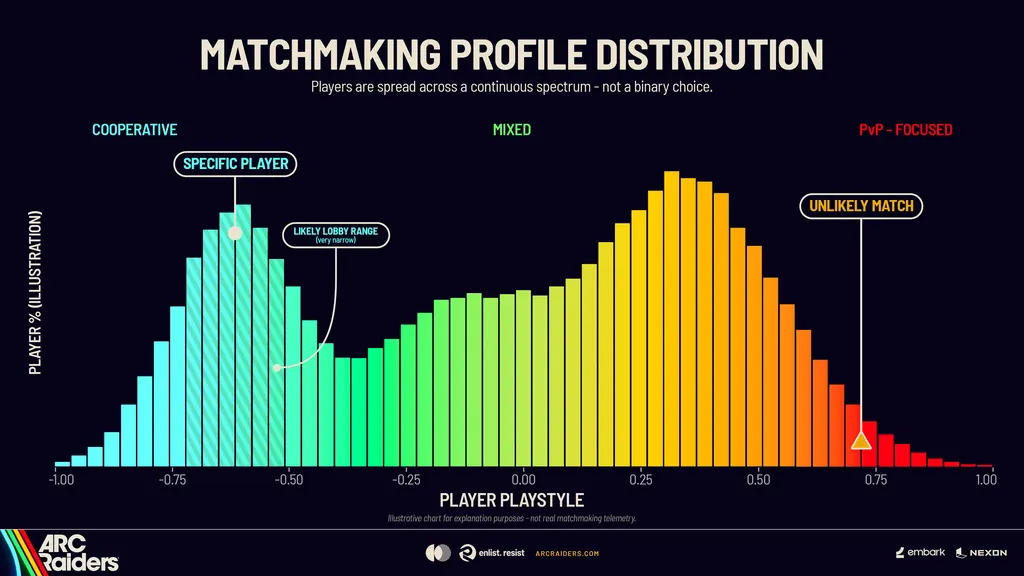
The read shifts gradually. A player’s behaviour shapes future lobbies over time rather than in a single jump, so one unusual round rarely swings the profile far. Embark also makes clear that the pairing is a tendency and not a promise. Similarity with lobbymates is more likely, not guaranteed, because the studio deliberately keeps a degree of unpredictability in who a player meets Topside.
Why Arc Raiders Has No Pure PvP or PvE Lobbies
Embark used the post to quash the idea of a binary lobby system. There is no full PvP instance where every Raider is hostile, and no full PvE instance where no one will shoot. The studio describes the lobby spread as a spectrum by design, built that way because unpredictability is treated as an essential part of the multiplayer experience.
Arc Raiders builds its core tension around that uncertainty. Raiders head Topside to scavenge in a world overrun by hostile ARC machines, and every other player they meet can be a potential ally or a threat. Matchmaking that sorted everyone into guaranteed-safe or guaranteed-hostile lobbies would flatten that tension, which is why Embark treats the spectrum as a design feature rather than a problem to solve.
The idea that a player belongs to one specific lobby type, Embark says, has always been a bit of a fallacy. That belief pushed people to play Arc Raiders in an unnatural way, adjusting their behaviour purely to try to game the system into a particular kind of lobby rather than playing how they wanted. By explaining the spectrum directly, the studio is trying to remove the incentive to perform for the matchmaker.
The stated goal of the pairing is to reduce friction and increase enjoyment. Grouping players of a similar playstyle means a cooperative Raider is less likely to load into a round full of opponents hunting kills, and a PvP-focused player is less likely to spend a round chasing teammates who only want to loot. The spectrum still leaves room for surprise, because Topside is never meant to feel completely predictable.
Self-Defence No Longer Counts as Aggression
The first of the two adjustments changes how the system records a fight. Before the change, any fight counted as an act of aggression, including one where a player was purely defending themselves. The system did not capture who had started the encounter, so a Raider who was ambushed and returned fire was logged the same way as the Raider who opened up first.
The updated system now captures whether a player started a fight. A Raider who is attacked and defends themselves no longer has that exchange read as aggressive behaviour, which means self-defence will not gradually nudge them toward more PvP-heavy lobbies. The change answers a long-running complaint that the matchmaking quietly counted survival against players who never chose to fight.
Cooperative players stand to feel this most. Under the old behaviour, a single forced firefight fed into the profile as aggression, and a careful, loot-focused Raider could drift toward lobbies full of more combative opponents simply for staying alive. Reading who started the fight, rather than the bare fact that a fight happened, keeps that player closer to the cooperative end of the scale where their actual playstyle sits.
Shorter Rounds Now Carry Less Weight
The second adjustment changes how much a short round feeds into a player’s profile. Shorter rounds no longer carry as much impact on deciding a player’s playstyle. A round that ends quickly, whether through an early death or a fast extraction, gives the system far less behaviour to work with than a full-length run.
Lowering the weight of those rounds reduces the chance that a brief, unrepresentative session skews the playstyle read. A Raider who drops in, takes one unavoidable fight, and exits within a couple of minutes will not have that thin sample treated as a strong signal of how they usually play. The longer, more complete rounds, where a player makes a string of choices about whether to engage or avoid other Raiders, carry the bulk of the weighting instead.
Round length varies widely in an extraction shooter like Arc Raiders. A run can end seconds after landing or stretch across a long, cautious sweep of the map toward an extraction point. Weighting the longer rounds more heavily means the profile leans on sessions where a Raider had the time and the opportunities to show a consistent pattern, rather than the rushed runs that reveal little.
The two adjustments point at the same outcome. Both the self-defence fix and the shorter-round change are aimed at a playstyle profile that reflects how a Raider behaves across full sessions, rather than one thrown off by a single isolated fight or an incomplete round.
The Matchmaking Myths Embark Wants to Settle
Embark closed the post by addressing a set of recurring assumptions about matchmaking, several of which it says are simply untrue. The studio laid out the following points directly:
- There are not only two kinds of lobby, because the system runs on a continuous scale rather than a PvP-or-PvE choice.
- One shot or one kill does not immediately move a player into PvP-focused lobbies.
- There are no PvE-only lobbies or servers where other Raiders will never attack.
- A player’s loadout does not affect matchmaking.
- Patches and updates do not reset a matchmaking profile.
- Looting knocked-out players does not affect matchmaking.
- Turning crossplay on or off does not change the level of cooperation or PvP in a round.
Several of those points close off the vectors players had used to try to steer their lobbies. Because a loadout carries no weight, gearing up heavily for a fight does not mark a Raider as aggressive, and because looting downed players is ignored, scavenging a knocked-out Raider is not logged as hostile. The note on patches matters for anyone who assumed an update wiped the slate clean, since a matchmaking profile persists across updates and behaviour from before a patch still feeds the lobbies a player sees afterward. The clarification on crossplay removes another common theory, confirming that switching it off does not deliver quieter, more cooperative rounds.
With the system now explained in full and the two fixes in place, the next read on Arc Raiders matchmaking will come from how lobbies feel to players over the coming weeks, and whether the self-defence change visibly shifts where cooperative Raiders land on the scale.