
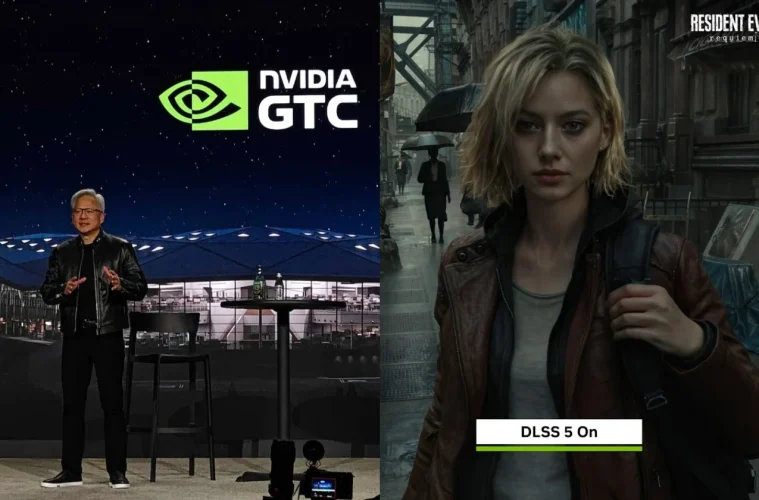
Nvidia has responded directly to the growing DLSS 5 backlash, with CEO Jensen Huang pushing back strongly on criticism and insisting the concerns are misplaced. Speaking during a press Q&A at GTC 2026, Huang said gamers and critics questioning the technology are “completely wrong”, while stressing that developers still control how games look, not Nvidia’s AI.
Following the announcement of DLSS 5, some gamers expressed concerns that the technology causes games to appear worse, look homogeneous, or force a specific aesthetic defined by #Nvidia.
At a Q&A Panel at #NvidiaGTC, #JensenHuang fired back. 🔥#gaming #dlss5 pic.twitter.com/Tjr60BCcmQ
— PCMag (@PCMag) March 17, 2026
The response follows widespread debate over DLSS 5’s early demos, particularly around its AI-driven visual changes and whether they compromise artistic intent.
Jensen Huang Pushes Back At DLSS 5 Criticism
During the Q&A, Huang was asked about claims that DLSS 5 creates worse or more homogenised visuals. In response, he dismissed the criticism outright.
“Well, first of all, they’re completely wrong,” Huang said when addressing concerns raised by media and players, according to reporting from Tom’s Hardware.
He explained that DLSS 5 integrates generative AI directly into core rendering elements like geometry and textures, rather than applying superficial effects. This, he argued, allows the technology to enhance visuals without overriding a game’s original design.
Huang also emphasised a key point behind Nvidia’s positioning. “We created the technology, we didn’t create the art,” he said, reinforcing that developers remain responsible for the final look of their games.
Neural Rendering Works At The Geometry Level
A major source of confusion around DLSS 5 has been comparisons to AI filters or post-processing tools.
Huang pushed back on that characterisation, explaining that DLSS 5 operates at a deeper level. “It’s not post-processing at the frame level, it’s generative control at the geometry level,” he said during the session, as reported by multiple outlets covering the event.
According to Nvidia, this approach, described as “neural rendering”, allows the system to understand 3D environments, motion, and materials, then enhance them using AI while staying grounded in the game’s original data.
Huang added that developers can fine-tune how the generative AI behaves, meaning the final result can match a specific artistic style rather than forcing a uniform look.
Backlash Focuses On Visual Changes And “Uncanny” Results
Despite Nvidia’s explanation, the early reception to DLSS 5 has been mixed to negative in some corners of the gaming community.
Criticism has largely centred on how the technology alters visuals, especially character faces. Some examples circulating online, including comparisons involving Resident Evil Requiem characters like Grace Ashcroft and Leon Kennedy, have been cited as looking overly smooth or unnatural, according to Tom’s Hardware.
Others have compared DLSS 5’s output to AI face filters seen on social media, while some critics argue it risks making games look more homogenised or reflective of Nvidia’s own visual preferences, rather than a developer’s intent.
Hands-on impressions have echoed similar concerns, with some noting that the current implementation can feel excessive, producing hyper-realistic results that fall into the “uncanny valley”.
Community Reactions Range From Skepticism To Support
Beyond media coverage, community reactions have been equally divided, with strong opinions emerging across forums and comment sections.
Some players have questioned Huang’s dismissal of criticism, arguing that visual preference is subjective and cannot simply be labelled as “wrong”. One commenter wrote that “no one is completely wrong or even slightly wrong at all… everyone is entitled to their view and opinion” .
Others pushed back on Nvidia’s messaging more directly, with some interpreting the response as dismissive or out of touch. Comments described the stance as “arrogant” or criticised the company for telling players how they should feel about what they are seeing .
There are also concerns around how DLSS 5 was presented. Some users argue that the early demos gave the impression of “generic gen AI” visuals, suggesting Nvidia failed to communicate the technology clearly or showcase its full potential .
At the same time, not all reactions have been negative. Some community members have urged patience, pointing out that the technology is still in an experimental stage and could improve significantly before release .
Others see long-term potential, comparing DLSS 5’s current reception to earlier versions of DLSS or even ray tracing, both of which faced criticism before becoming more widely accepted.
Nvidia Says The Current Version Is Still An Early Preview
Part of Nvidia’s defence rests on the current state of the technology.
The company has confirmed that DLSS 5 shown at GTC is an early preview, with the model still being optimised ahead of its planned release in late 2026, according to its own FAQ cited by PCMag.
That means the visuals drawing criticism now may not reflect the final implementation seen in shipped games.
Huang also pointed to Nvidia’s past experience with ray tracing, noting that it faced heavy scepticism when first introduced with RTX 20-series GPUs in 2018 before becoming widely adopted.
“Everybody said ray tracing was FUBAR,” Huang recalled, arguing that the technology eventually proved its value as it matured.
Developers Retain Full Creative Control
A central theme in Nvidia’s response is that DLSS 5 does not dictate how games should look.
Huang repeatedly stressed that developers have direct control over how the technology is used. He suggested studios can experiment freely, whether aiming for photorealism or more stylised visuals, with the AI acting as a tool rather than a decision-maker.
He also described DLSS 5 as “content-control generative AI”, highlighting that it is conditioned by the original game data rather than generating visuals independently.
DLSS 5 Debate Likely To Continue Until Release
With DLSS 5 still months away from release, the conversation around it is far from settled.
Nvidia is positioning neural rendering as a major step forward in graphics technology, potentially on par with the introduction of ray tracing. However, early reactions show clear concern about how far AI should influence the artistic side of game development.
As more demos and final implementations appear closer to launch, the industry will get a clearer picture of whether DLSS 5 enhances games in a meaningful way or reinforces the concerns currently driving the backlash.