
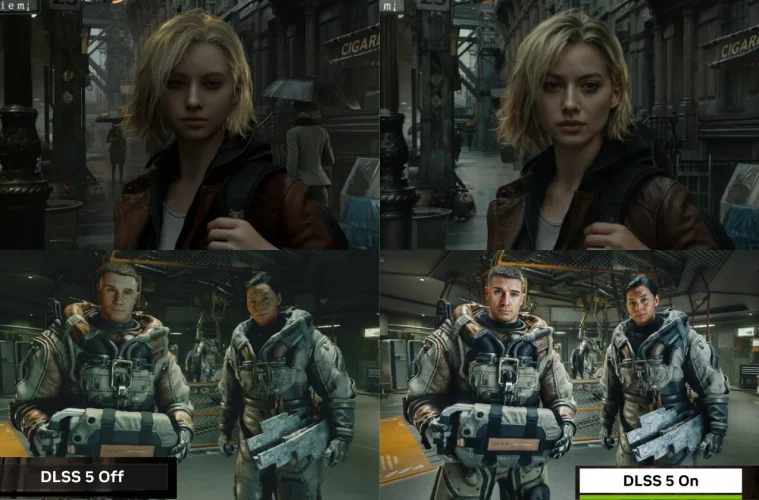
NVIDIA DLSS 5 was meant to be a breakthrough moment for game graphics, but instead, it’s quickly turning into one of the most divisive tech reveals in recent memory. While NVIDIA is pitching it as a leap toward photorealism, a growing number of developers and players are saying the opposite, arguing the visuals look artificial, uncanny, and in some cases, outright worse than the original games.
NVIDIA Promises A New Era Of Photorealism
Announced at GTC 2026, DLSS 5 introduces what NVIDIA calls a real-time neural rendering model. Instead of just upscaling resolution or generating extra frames like previous versions, this new system actively alters the image by adding AI-generated lighting, materials, and detail.
According to NVIDIA, DLSS 5 analyses a frame’s colour and motion vectors, then reconstructs it with “photoreal” lighting and materials while staying anchored to the original 3D scene.
CEO Jensen Huang described it as “the GPT moment for graphics”, positioning it as a fundamental shift in how games are rendered.
The company also emphasised that developers retain control, with tools for intensity, colour grading, and masking to preserve each game’s artistic style. DLSS 5 is set to launch in late 2026 and is already planned for major titles like Resident Evil Requiem, Starfield, Assassin’s Creed Shadows, and Hogwarts Legacy.
The Problem Players Are Seeing In DLSS 5
Despite the ambitious pitch, early footage has sparked immediate backlash. Instead of enhancing realism, many viewers say DLSS 5 makes characters look like they’ve been run through a generic AI filter.
In side-by-side comparisons shown by NVIDIA, character faces appear noticeably altered.
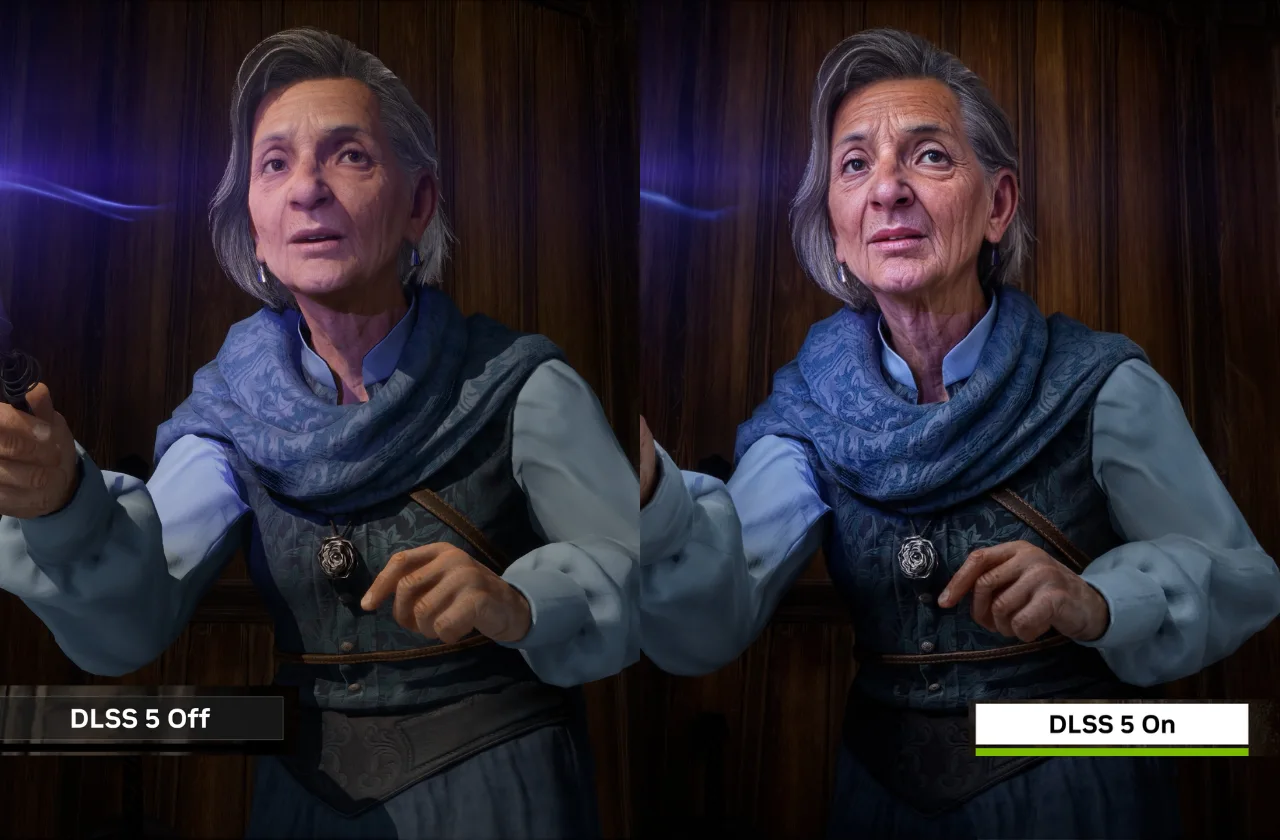
Features such as skin tone, facial structure, and even expressions shift in ways that weren’t present in the original game assets. Some viewers compared the effect to social media beauty filters, with exaggerated smoothness, sharper features, and a slightly “off” look that sits firmly in the uncanny valley.
One widely shared comparison contrasts Death Stranding 2’s original character model with a DLSS 5-enhanced version, highlighting just how dramatically faces can change.
Death Stranding 2 Nvidia DLSS 5 pic.twitter.com/6r4m3wEMDI
— TheGameVerse (@TheGameVerse) March 17, 2026
Just look at how good Death Stranding 2 already looks. It doesn’t need this. DLSS 5 comes in and straight up butchers the character, replacing it with something that looks like generic AI output.
Others pointed out inconsistencies like unnatural eye movement and overly processed textures, which resemble the wave of low-quality generative AI images often referred to online as “AI slop”.
This looks horrifically bad, nobody wants an AI slop filter on top of their games
— Synth Potato🥔 (@SynthPotato) March 16, 2026
This has led to a core criticism that DLSS 5 isn’t just enhancing visuals, it’s effectively replacing them with an AI interpretation.
Developers Are Publicly Pushing Back
The criticism isn’t just coming from players. Several developers and industry figures have openly voiced concerns about what DLSS 5 represents.
Dave Oshry, CEO of New Blood Interactive, didn’t hold back, calling the tech “AI dogshit” and warning that future generations might grow up thinking this kind of output looks normal. He also urged the industry to “push back harder” against it.
Arman Nouri, a senior environment artist at Epic Games, echoed similar concerns, saying it was depressing to think AI-generated visuals could become the standard for younger players.
Agree with this so much, watching my daughter grow up where AI slop is the norm and her not knowing quality of quantity really bums me out. Makes me appreciate my childhood a lot more.
— Arman Nouri (@armanguy) March 17, 2026
Michael Douse, publishing director at Larian Studios, took a more sarcastic approach, joking that Resident Evil Requiem felt “unplayable” without DLSS 5’s promised photoreal enhancements, clearly poking fun at NVIDIA’s marketing claims.
Playing some Resident Evil Requiem this morning. The game is great but I just wish it infused pixels with photoreal lighting and materials, bridging the gap between rendering and reality alas unplayable for now
— Very AFK (@Cromwelp) March 17, 2026
Even lighter reactions, like memes and jokes from across the industry, highlight the same underlying issue, that something about DLSS 5’s output just doesn’t look right.
Art Direction Versus AI Interpretation
One of the biggest sticking points is how DLSS 5 interacts with a game’s original art direction.
Modern AAA games already spend years refining character models, lighting, and materials to achieve a specific visual identity. Critics argue that layering generative AI on top risks flattening that identity into something more generic.
In examples like Resident Evil Requiem, characters reportedly end up looking like entirely different people once DLSS 5 is applied. That raises questions about whether the technology respects artistic intent, or overrides it.
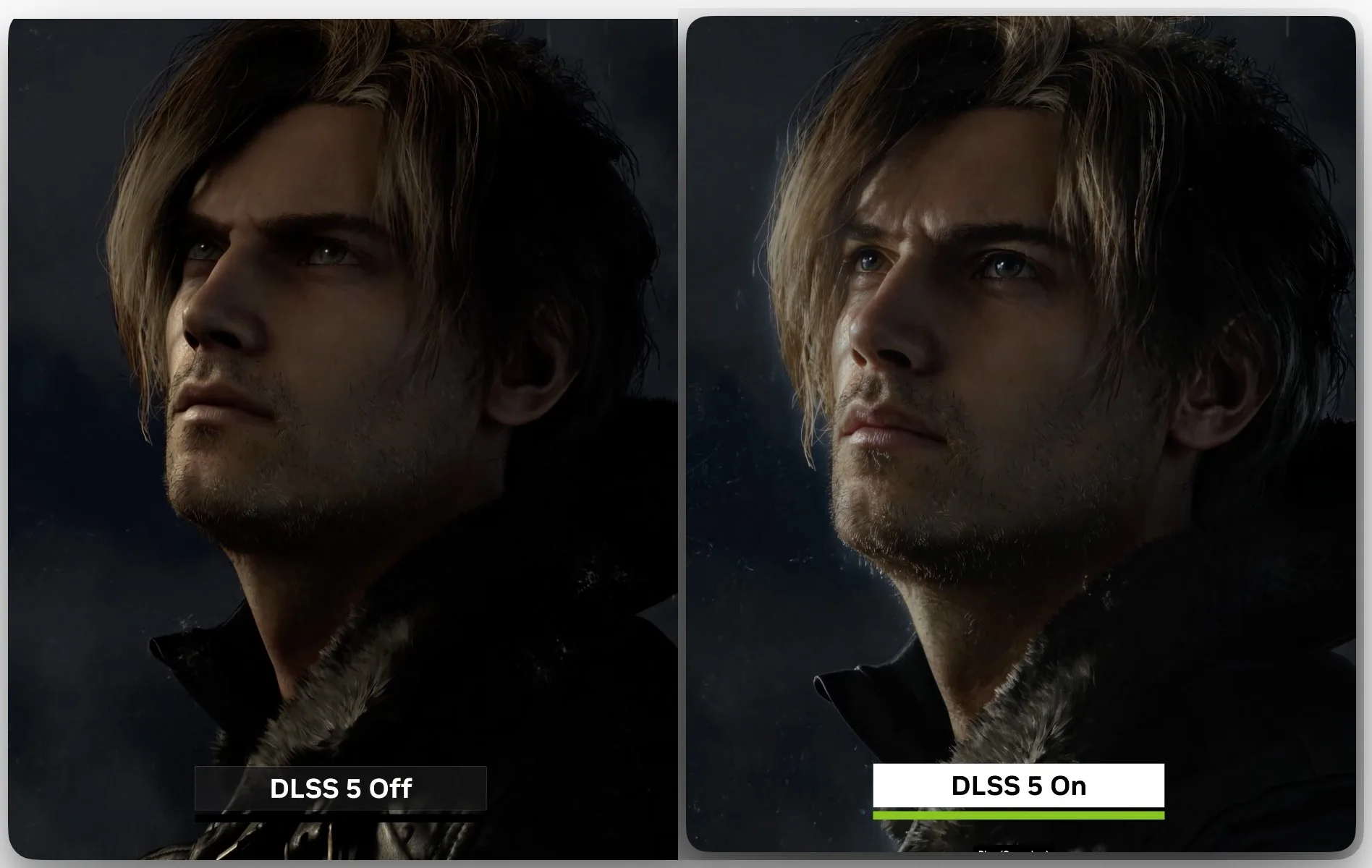
NVIDIA maintains that developers can fine-tune the effect, but early reactions suggest that even with control options, the underlying AI transformation may still introduce unwanted changes.
DLSS 5 Still Has Industry Support Despite The Backlash
It’s worth noting that not everyone is against DLSS 5. Major studios including Bethesda, CAPCOM, Ubisoft, and others are already onboard, with plans to integrate the technology into upcoming releases.
From a technical perspective, the idea of bridging the gap between real-time rendering and film-quality visuals is something the industry has been chasing for decades. DLSS 5 attempts to solve that problem not through raw hardware power, but through AI reconstruction.
There’s also a practical angle. Real-time rendering budgets are extremely limited compared to film production, where a single frame can take hours to render. DLSS 5 aims to simulate that level of detail instantly, which, in theory, could unlock new possibilities for game visuals.
The Bigger Question Around AI In Game Graphics
The strong reaction to DLSS 5 highlights a broader tension in gaming right now. AI tools are becoming more powerful, but not everyone agrees they should be used to reinterpret finished artwork.
For some players and developers, the appeal of games comes from handcrafted detail and intentional design choices. If AI starts modifying those elements in real time, even slightly, it raises concerns about authenticity and consistency.
At the same time, NVIDIA is unlikely to back away from this direction. DLSS has already become a standard feature across hundreds of games, and DLSS 5 represents the next step in that evolution, whether players like it or not.
The real test will come when DLSS 5 launches later this year and players can experience it firsthand. Right now, based on early footage and reactions, the technology might be aiming for realism, but for many, it’s landing somewhere much stranger.