
When a platform has been around for almost a decade and has grown from a small project to one of the largest CS2 case-opening sites, questions of trust inevitably arise. On the one hand, Hellcase remains one of the most recognizable platforms in the niche: millions of users, a huge number of daily case-openings, and a stable infrastructure. On the other hand, its sheer scale gives rise to copycats, phishing pages, and scammers who exploit the brand’s popularity to deceive newcomers. Therefore, the question “Is Hellcase still legit?” regularly arises in discussions and on forums. To answer honestly and without emotion, it’s enough to consider key facts: the project’s history, its security system, official information, the presence of transparent mechanisms, and the fraudulent schemes most commonly encountered by users.
What Is Hellcase, And Why Is It Trusted?
Hellcase launched in 2016, and this fact alone sets it apart from most websites that pop up, operate for a couple of months, and then vanish without a trace. Here, the situation is the opposite: the project not only operates stably but is also constantly evolving. New mechanics, events, interface improvements, and results verification systems are being added.
Trust isn’t built solely on the project’s age. More important are its reputation and the actual scale of its operations:
- Millions of users
- Multi-tiered technical infrastructure
- Constant functionality updates
- Active blog with news and explanations
- Developed a system of partner integrations.
Hellcase isn’t a typical website built on a template. It’s a full-fledged service with its own logic, design, economics, and fair discovery system.
Provably Fair: The Foundation of Hellcase’s Honesty
When it comes to legitimacy, the first thing to evaluate for case sites is the randomness mechanism. Hellcase uses a Provably Fair system, which allows each user to verify for themselves that the opening result has not been manually altered.
How it works:
- The site generates a hash (server seed).
- Your browser generates its own value (client seed).
- This data is combined into a unique opening result.
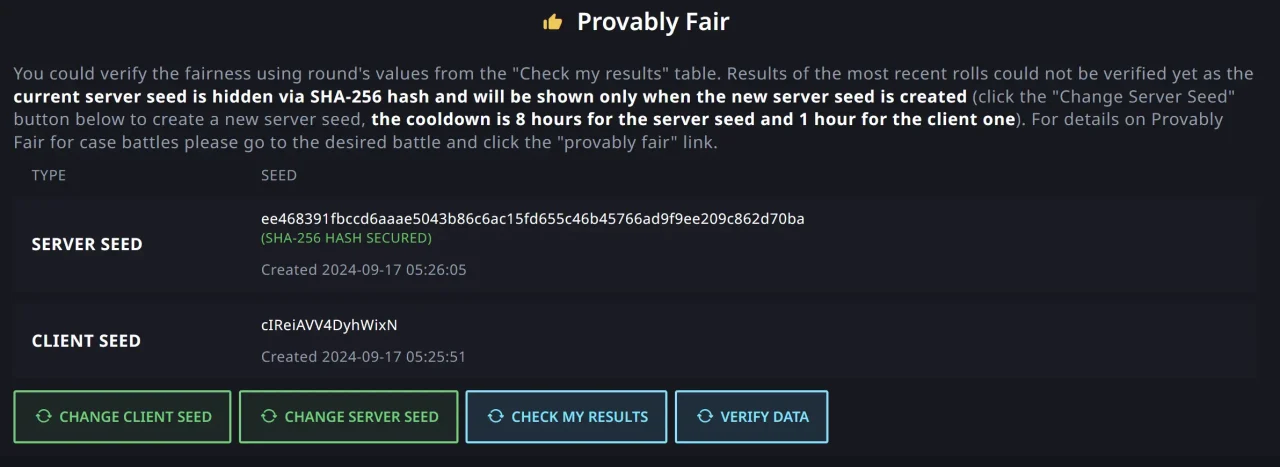
After the item drops, the system reveals the values, and the user can verify how the program arrived at the final drop.
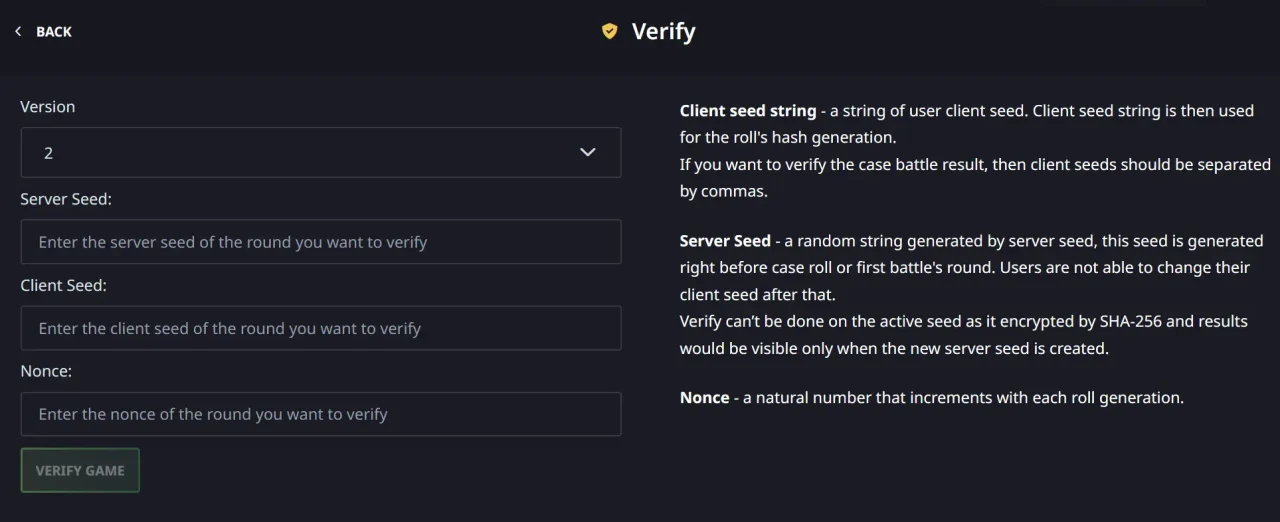
Most importantly, site administrators cannot interfere with the process. The system eliminates human error and ensures transparency, as confirmed by both users and independent reviews. Many competing sites only claim to have a fair algorithm, but on Hellcase, the mechanism truly works and is available for verification at any time.
Why Are There Doubts About Hellcase?
It’s important to emphasize here: the source of doubt isn’t Hellcase itself, but the vast number of counterfeit copies using the brand. When a site gains popularity, scammers begin launching dozens of nearly identical fakes. The differences are minimal:
- One letter replaced: helfcase, hellecase
- Character substitution: heIlcase (uppercase i instead of l)
- Number instead of letter: hel1case
- Addition of an extra letter: helcasee
- Subdomains masquerading as “official” pages.
Visually, these sites completely replicate the Hellcase interface: the same colors, logo, design, top-up pages, and profile. Users are confident they’re on the original resource, only to later realize that items aren’t being withdrawn, their balance has disappeared, and their card or Steam account information has ended up in the hands of scammers.
Therefore, questions about the authenticity of the site are a logical consequence of the brand’s growth, not a problem with Hellcase.
Official Scam Alert Section: User Protection
The original Hellcase website has a dedicated Scam Alert section, which contains information about scams, examples of fake domains, and how to protect yourself. This is one of the most underrated, yet extremely useful, elements of the platform.
It explains:
- How scammers disguise themselves as Hellcase
- Which domains are fake
- Which channels are most often used for phishing attacks
- How to distinguish a real website from a copy
- How to avoid scams, free skins, and fake tech support
What’s important: Hellcase doesn’t hide the existence of scammers. On the contrary, the platform warns of threats and educates users on safe behavior. This approach is extremely rare in the industry.
Particular attention is paid to common scams:
- Fake giveaway pages
- Advertisements with phishing links
- Cloned domains that differ by one or two letters
- Account hijacking
- Credit card fraud
Scam Alert also recommends: always check the address bar, use only the official website, avoid clicking links in private messages, and avoid entering card details into suspicious forms.
Conclusion
Ultimately, Hellcase remains a reliable platform that has been operating steadily and openly for many years. All key features, including Provably Fair and transparent withdrawal procedures, confirm that the original site is honest and secure. The main problems arise not from the platform itself, but from the many fake copies that try to capitalize on the brand’s popularity. Therefore, the main recommendation is simple: check the domain, avoid dubious links, and use the official website.