
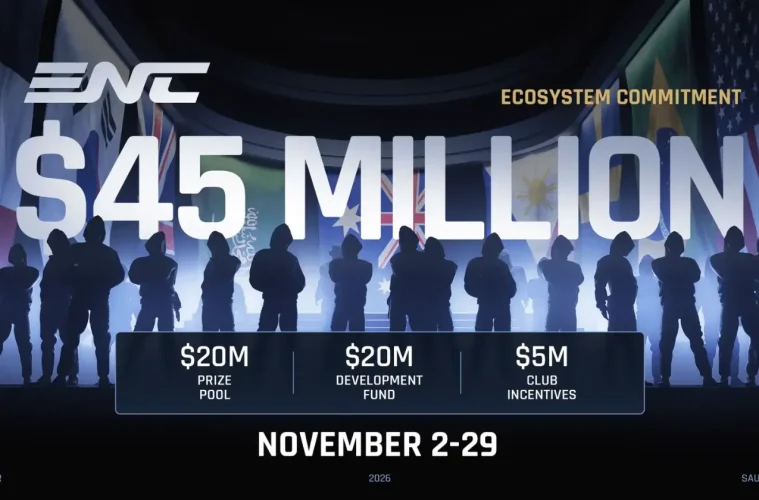
The Esports Nations Cup 2026 has officially unveiled its full financial framework, with the Esports World Cup Foundation (EWCF) committing $45 million USD to support players, Clubs, and national teams at the tournament’s inaugural edition.
Set to debut in Riyadh, Saudi Arabia, from November 2 to 29, 2026, the Esports Nations Cup introduces a national team format to the global esports calendar, running alongside the existing Club-based Esports World Cup and giving players the chance to compete for country rather than organisation.
A Three-Pillar $45 Million Commitment
EWCF’s investment is structured around three funding pillars designed to stabilise participation and encourage top-tier competition.
The largest portion includes $20 million in prize money, paid directly to players and coaches across 16 competitive titles. Every qualified participant will earn prize money, with all teams guaranteed a minimum of three matches.
A further $5 million has been allocated to Club release incentives, rewarding professional esports organisations that allow contracted players to represent their countries. These incentives are performance-based and paid separately from player winnings.
The remaining $20 million will be delivered through the previously announced Esports Nations Cup Development Fund, supporting official national team partners with logistics, travel, programme operations, marketing, and long-term national pathway development.
Equal Placement, Equal Pay Across All Games
A defining feature of ENC 2026 is its placement-based prize framework, which applies uniformly across all titles. Players earn the same payout for the same finishing position, regardless of whether they compete in solo or team-based games. Coaches are rewarded alongside players at the same placement level.
A first-place finish awards $50,000 per player, second place earns $30,000, and third place receives $15,000. For team titles, total payouts scale with roster size, maintaining consistency and transparency across the competition.
Guaranteed per-player payouts extend deep into the bracket, with earnings for all placements down to the Round of 128. Some figures are adjusted slightly to account for different tournament formats, such as 24-slot versus 32-slot brackets, to ensure fairness across titles.
Club Incentives Tied Directly To Performance
To address long-standing concerns around player availability for nation-based events, ENC introduces a clear incentive structure for Clubs. If a player reaches the Top 16, their organisation receives a 40 percent bonus on that player’s prize earnings.
For example, if a Club releases three players who each win a title, earning $50,000 apiece, the organisation would receive a $60,000 incentive payment on top of player winnings. This model is designed to reduce friction between national teams and professional organisations, particularly during busy transfer windows.
National Teams Take Centre Stage
According to Ralf Reichert, CEO of the Esports World Cup Foundation, the Nations Cup is intended to introduce a more accessible and identity-driven layer to elite competition.
National teams, he explained, create new rivalries, clearer narratives, and stronger emotional investment for fans, while the funding model aims to balance short-term competition with long-term ecosystem growth.
Confirmed Games And Event Structure
So far, Mobile Legends: Bang Bang, Trackmania, and Dota 2 have been confirmed for ENC 2026, with additional titles expected to be announced in the coming weeks.
The Esports Nations Cup will be held every two years and is planned to move to a rotating host-city model after its Riyadh debut, positioning it as a recurring fixture in the international esports calendar.
Context And Ongoing Criticism
The event was formally announced in August 2025 and follows Saudi Arabia’s withdrawal from plans to host the Esports Olympic Games. As with other Saudi-backed esports initiatives, EWCF and ENC have faced ongoing criticism from international watchdog groups, including Amnesty International and Human Rights Watch, which accuse the projects of contributing to so-called sportswashing.
Despite this, the scale and structure of ENC 2026 represent one of the most significant financial commitments ever made to a nation-based esports competition.
With $45 million secured, equal pay guaranteed, and long-term national development funding in place, the Esports Nations Cup is positioning itself as a foundational experiment in how international esports could be organised in the years ahead.