
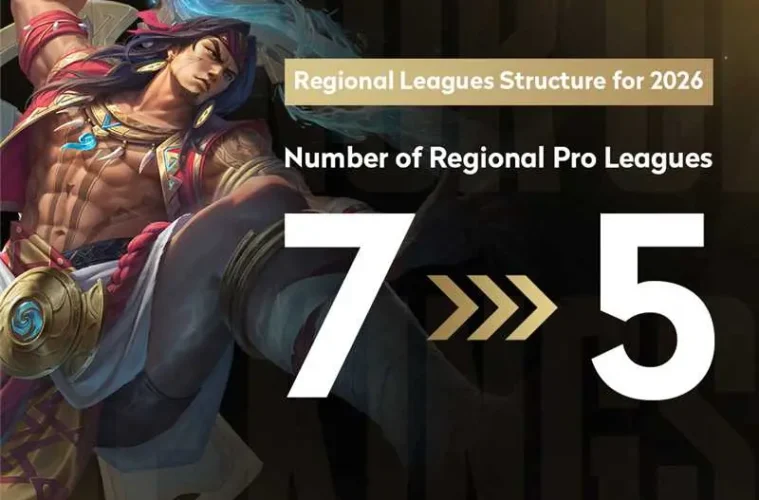
Honor of Kings has officially lifted the curtain on a sweeping set of changes for its global esports ecosystem in 2026, revealing a new league structure alongside updated roster rules designed to create a more balanced and sustainable competitive scene.
2026 Regional League Structure & Roster Rules Announced! 💪#shinehok #2025HOK #HonorofKings #HOKEsports pic.twitter.com/NoLqzQhpp4
— HoK Esports (@HoKEsports) December 30, 2025
Announced by Honor of Kings Esports and publisher Level Infinite, the overhaul reshapes how regions compete internationally, while also tightening regulations around team composition and imports. According to the organisers, the goal is clear, to foster a more evenly matched landscape and give local talent a stronger platform on the professional stage.
A new global league takes centre stage
The headline change for 2026 is the introduction of the Honor of Kings Major League, commonly referred to as KML. This new cross regional competition merges three existing leagues, the Wildcard Kings Series, Major West League, and Major East League, into a single global league.
As a result, Level Infinite’s international ecosystem is streamlined into five core leagues for the 2026 season:
- Honor of Kings Major League (KML)
- Indonesia Kings League (IKL)
- Philippines Kings League (PKL)
- Malaysia Kings League (MKL)
- Brazil league (CHOKBR)
This marks a shift from seven international leagues down to five, bringing teams from Asia, Europe, the Americas, and the Middle East into a more unified competitive structure. Alongside this, professional teams from Macau and Hong Kong will return to the Chinese Mainland esports ecosystem.
Running in parallel to these international leagues will be the long standing Chinese franchised competition, the King Pro League, which remains exclusive to teams based in China.
Regional divisions restructured for imports
To support the new format, Honor of Kings is also restructuring its regional divisions for the purpose of defining resident and import players. From 2026 onwards, the ecosystem will operate across six regional divisions:
- Americas, covering North America, South America, and Brazil
- Europe, including West Europe, East Europe, and Türkiye
- MEA, spanning the Middle East and Africa
- Pacific, covering South Asia, South Korea, Japan, and Australia
- Southeast Asia
- Greater China, including the Chinese Mainland, Hong Kong SAR, Macau SAR, and Chinese Taipei
This restructuring plays a key role in how roster eligibility and import limits are applied across competitions.
Roster rules tightened for 2026
Alongside the league changes, Level Infinite has confirmed updated roster rules that will apply to all teams competing in the 2026 Honor of Kings esports season.
Teams must register a minimum of five players and can carry a maximum of seven on their active roster. Each team is allowed to sign up to one import player who is not a resident of the team’s home regional division.
There are also clear requirements around local representation. Every team must include at least two players who are residents of the country or territory the team represents. In addition, at least four players on the roster must be residents of the team’s wider regional division, including those counted under the country requirement.
Special restrictions apply to players from the Greater China division. Players holding nationality or citizenship from Greater China can only be classified as residents when competing within that same division. In all other regions, they will be treated as import players without exception, reflecting China’s long standing dominance in the competitive scene.
A focus on balance and local talent
According to Level Infinite, these changes are part of a broader vision for 2026 that prioritises long term growth over short term results. By reshaping leagues and limiting imports, the publisher aims to create closer competition between regions, while also opening more opportunities for domestic players to develop and shine.
With Honor of Kings continuing to post record viewership numbers and expand its presence outside China, the 2026 season is shaping up to be a defining moment for the game’s global esports ambitions.